Utsuro-bune (the hollow ship)
Illustrations
AI-generated illustration — not actual footage or evidence; an interpretive depiction based on the documented account
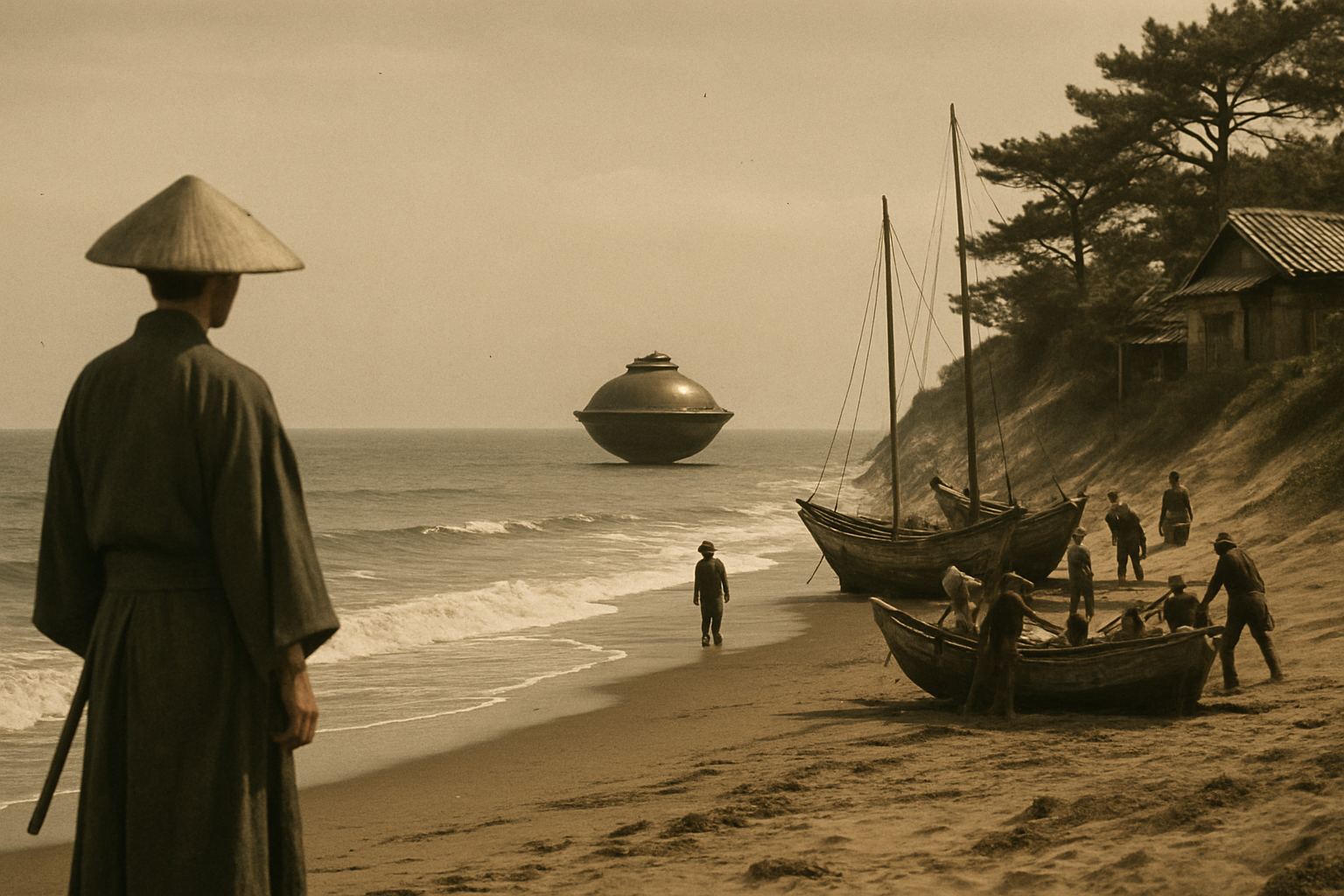
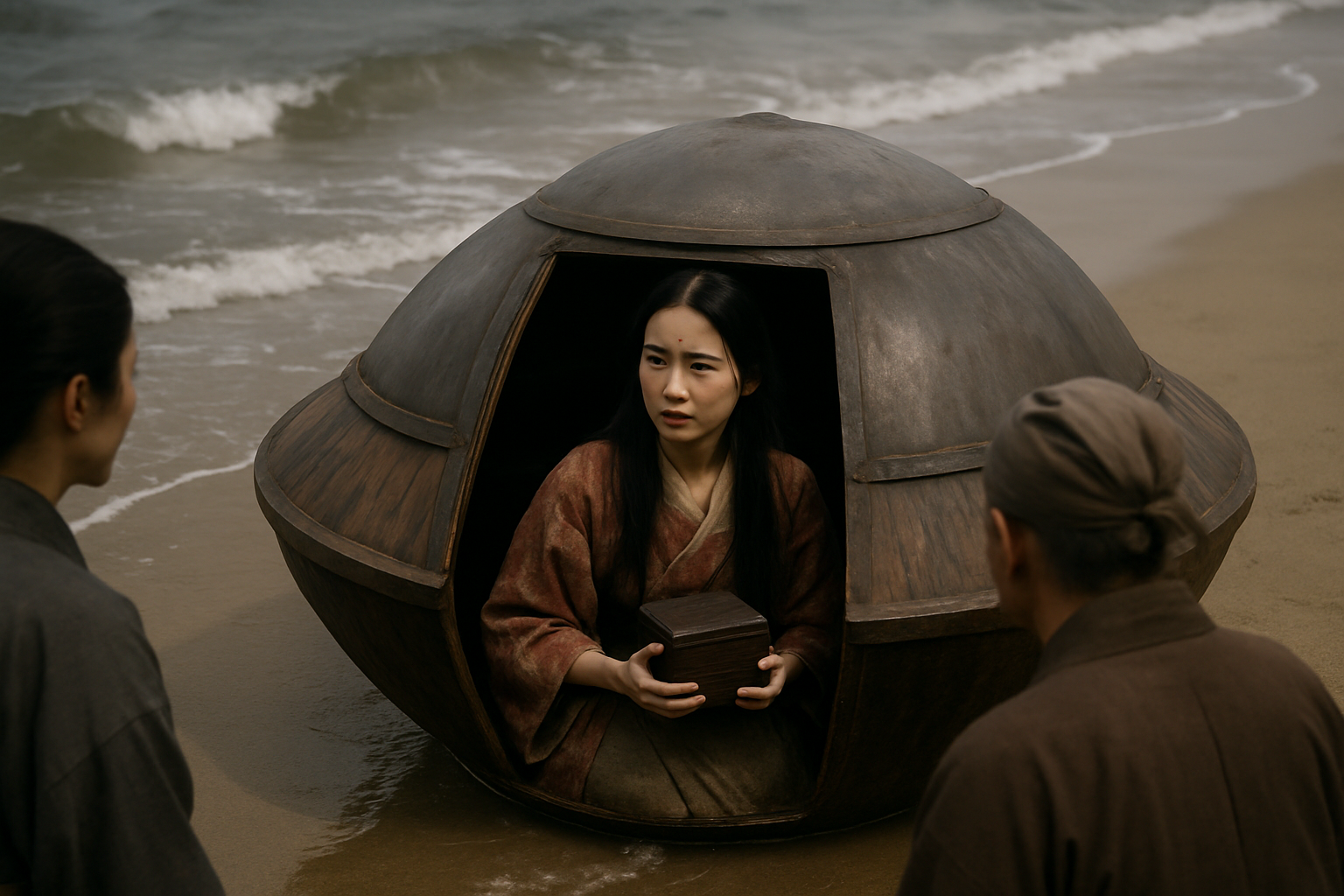
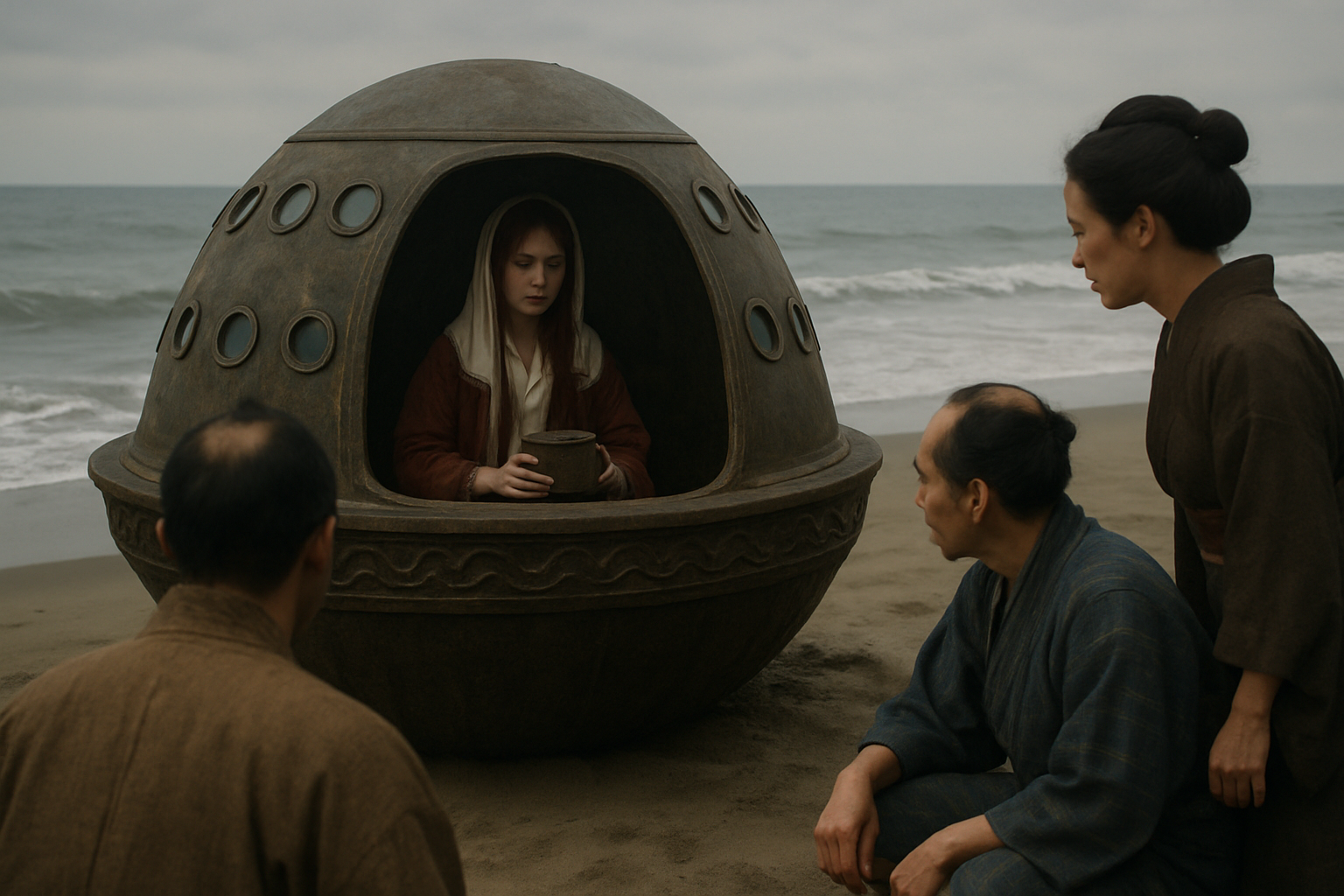
Utsuro-bune (Japanese: 虚舟, "hollow ship"; also written うつろ舟 and rendered *Utsuro-fune* or *Urobune*) is a Japanese legend that describes a strange round vessel said to have drifted ashore on the Pacific coast of Hitachi Province (present-day Ibaraki Prefecture) in 1803, during the Edo period.[1] According to the accounts, local fishermen found a sealed, incense-burner-shaped craft of red lacquered wood and metal plating, inside which sat a well-dressed young woman of unfamiliar appearance who could not make herself understood and who held a small box she refused to let anyone touch.[3] Unable to communicate with her and fearful of involvement with the authorities, the villagers are said to have pushed the vessel back out to sea.[3] The tale is not recorded in any contemporary official document and survives only in a handful of early-nineteenth-century essay collections and books of curiosities.[1] Since the twentieth century it has frequently been cited by UFO writers as an early Japanese close-encounter report, but scholars reject any extraterrestrial reading: the engineer Kazuo Tanaka describes the surviving tale as essentially "a literary mixture of folklore and imaginations,"[2] while also arguing that a real, mundane incident on the Hitachi coast may lie at its root.[3]
The account
The fullest surviving version appears in *Tōen shōsetsu* (兎園小説, "Tales from the Rabbit Garden"), a collection compiled in 1825 by the writer Kyokutei Bakin and his circle.[2] In it, fishermen of Hitachi Province sight an unfamiliar object offshore on 22 February 1803 and tow it to the beach. The craft is described as round, resembling a *kōro* (a Japanese incense burner) or a covered rice pot, about 3.3 metres high and 5.4 metres across; its upper part is said to be of red-lacquered wood fitted with windows of glass or crystal sealed with *chan* (pine resin), and its lower part reinforced with iron plates.[1][3] Inside sits a woman estimated at about eighteen to twenty years old, pale-skinned with red hair and eyebrows, dressed in fine unfamiliar clothing and holding a square box roughly 0.6 metres on a side that she guards closely.[3] The interior is said to bear unreadable writing, and provisions such as water and food are noted. Unable to learn her name or origin, and wary of being held responsible, the villagers are said to have set the vessel adrift again.[3]
Historical sources
The story is known only from Edo-period manuscripts and printed miscellanies, not from administrative records. Tanaka Kazuo has catalogued numerous documents relating to the Hitachi version of the legend.[3] The principal texts that describe the 1803 Hitachi landing include *Ōshuku zakki* (鶯宿雑記), compiled by Komai Norimura around 1815; *Tōen shōsetsu* (兎園小説, 1825); *Hyōryū kishū* (漂流紀集, "Records of Castaways"), of uncertain authorship and dated to roughly 1835 or later; and *Ume no chiri* (梅の塵, "Dust of the Plum"), written by Nagahashi Matajirō in 1844.[2][3] These versions disagree on key points — for example, *Ume no chiri* gives a different date and a different place name, "Haratonohama" — which scholars take as a sign that the tale circulated and mutated as a piece of popular storytelling rather than as a fixed eyewitness report.[2] Related but distinct *utsuro-bune* anecdotes also appear elsewhere: the *Hirokata zuihitsu* (弘賢随筆) records a hollow boat carrying a single woman that came ashore at Toyohashi (in present-day Aichi Prefecture) in 1698 — more than a century before the Hitachi episode — which the English-language Wikipedia treats as a separate sighting rather than part of the 1803 story.[2]
Research and explanations
Early commentators were already sceptical. The folklorist Yanagita Kunio, who discussed the story in the twentieth century, dismissed the *Tōen shōsetsu* account as a tall tale while noting that round boats themselves were not unknown in Japan and suggesting links to older legends.[1] The most detailed modern study is by Kazuo Tanaka, a professor emeritus of engineering at Gifu University, who examined the surviving manuscripts. Drawing partly on Yanagita's earlier work, Tanaka concluded that the tale as it has come down to us is essentially "a literary mixture of folklore and imaginations," and that the craft of the legend — which never flies or moves under its own power and shows no sign of extraordinary technology — bears no resemblance to a UFO.[2] At the same time, Tanaka does not regard the story as pure invention: in a 2020 interview he said he "feel[s] it was probably based on something that really happened," suggesting that a brief, real incident along the Kashima coast may have become intertwined with older *utsuro-bune* folklore.[3] He found that the landing place named in most accounts, "Harayadori" (and the variant "Haratonohama"), does not appear on period maps and seems to be invented, but he singled out one document, the *Banke monjo*, which instead names "Hitachihara Sharihama" — a real beach that appears on the maps of the cartographer Inō Tadataka and corresponds to present-day Sharihama in Hasaki, now part of Kamisu, Ibaraki Prefecture — and judged that variant comparatively reliable.[3] Scholars have also proposed that the figure of the foreign woman drew on contemporary anxieties about Russia and other outside powers at a time when Japan was largely closed, and that the legend may be connected to the local *Konjiki-hime* ("Golden Princess") sericulture myth.[1][3]
Reception and popular culture
From the late twentieth century onward, the Utsuro-bune was taken up by writers on unidentified flying objects, who pointed to its disc-like shape, sealed windows and the woman's unreadable script as suggestive of an extraterrestrial craft, and it is now widely circulated online as a candidate for an early Japanese UFO encounter.[2] The case has been featured in Japanese and international media and exhibitions, including images held in public-domain collections, and remains a popular subject in books on Edo-period mysteries.[3] Most academic commentators, however, continue to treat it as folklore: a vivid product of Edo storytelling that combined imported curiosities, fear of the foreign and existing local legends.[1][3]
Key quotes
“The boat was round like an incense burner, more than three ken long; the upper part had glass windows sealed with pine resin, and the bottom was reinforced layer upon layer with iron plates. (paraphrasing Tōen shōsetsu)
“Kazuo Tanaka concluded that the tale of the Utsuro-bune was "a literary mixture of folklore and imaginations," while adding that he "feel[s] it was probably based on something that really happened."
References
- 1.
- 2.
- 3.
Similar cases
Scored on agency / year proximity / region / tag overlap — same agency +3, near year +4, same region +2, shared tag ×2.