Disappearance of Frederick Valentich
Illustrations
AI-generated illustration — not actual footage or evidence; an interpretive depiction based on the documented account
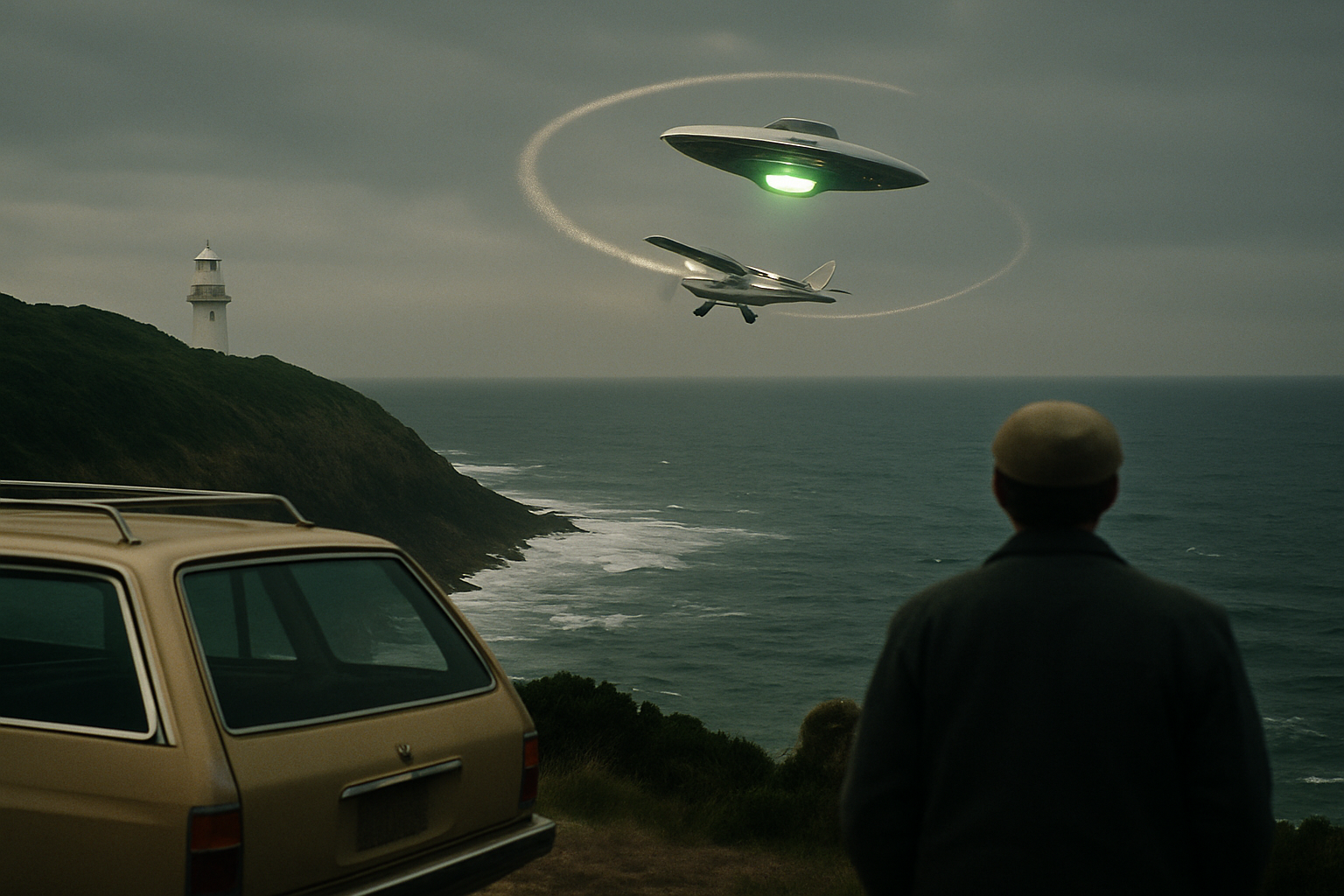
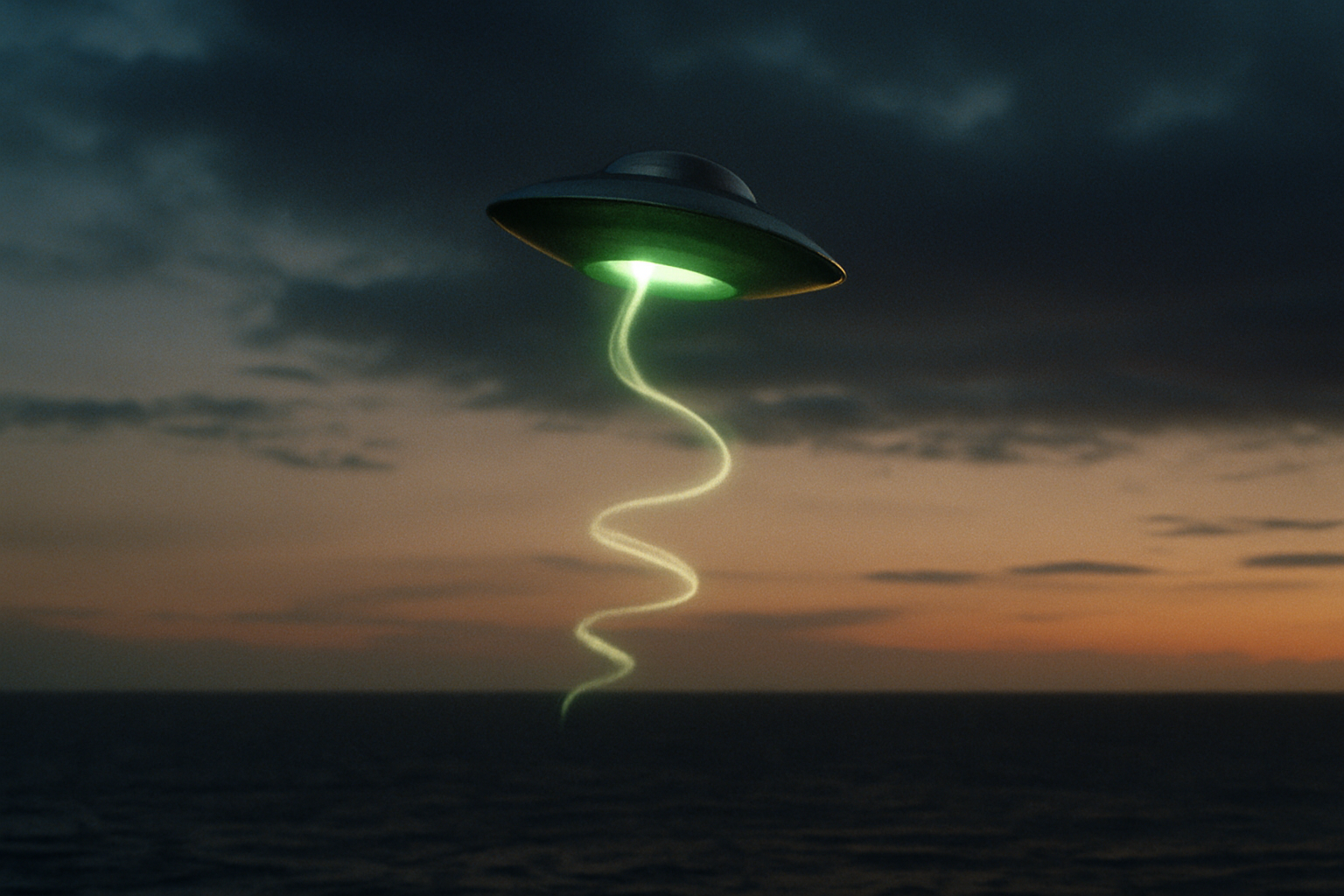
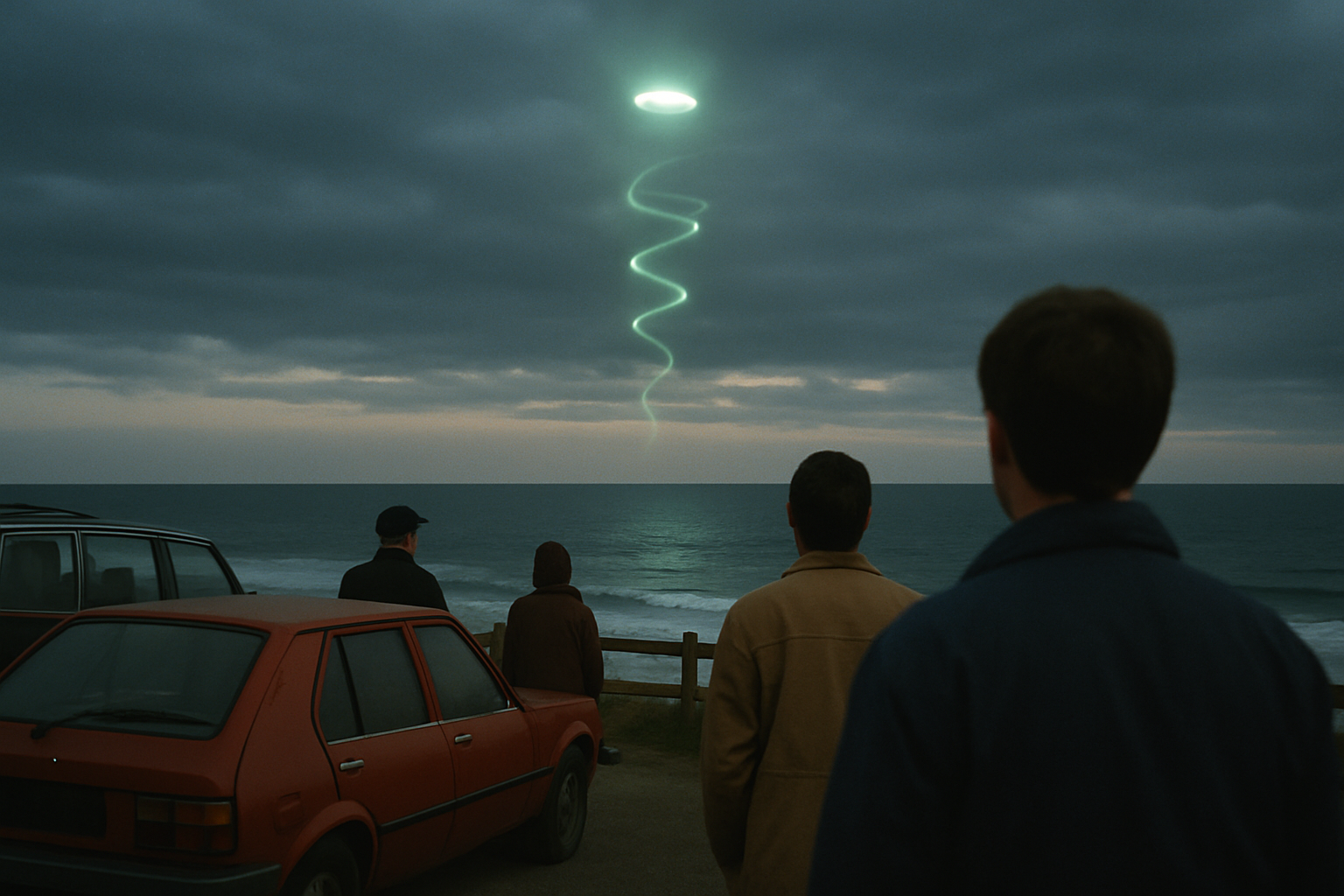
The disappearance of Frederick Valentich was the unexplained loss of a 20-year-old Australian pilot who vanished on the evening of 21 October 1978 while flying a Cessna 182L (registration VH-DSJ) on a 125-nautical-mile (about 232 km) flight across Bass Strait from Moorabbin Airport, near Melbourne, toward King Island.[1] Beginning at about 19:06 local time, Valentich repeatedly radioed Melbourne Flight Service to report that an unidentified aircraft with bright lights was following and orbiting above him, that it had "a green light and sort of metallic" shiny surface, and that his engine was running rough.[1][3] His final intelligible transmission—"it is not an aircraft"—was followed at 19:12:28 by an open microphone carrying roughly seventeen seconds of unexplained metallic, scraping sounds, after which all contact ceased.[3][2] No wreckage or body was ever recovered, despite an extensive air and sea search.[1] The Australian Department of Transport investigation could not determine the cause and recorded the pilot as presumed dead; subsequent analysts have proposed spatial disorientation and a "graveyard spiral" as the most likely mundane explanation, while UFO proponents continue to treat the case as a notable encounter.[2][1]
Background
Frederick Valentich was born on 9 June 1958 and was 20 years old at the time of his disappearance.[1] He held a class-four instrument rating, which permitted night flying only in visual meteorological conditions, and had accumulated about 150 flying hours, a comparatively low total.[2] According to skeptical accounts, he had failed commercial-pilot examinations on several occasions and had previously been involved in incidents for flying into cloud, an offence for a pilot of his rating.[2]
Valentich was described as a UFO enthusiast. His father, Guido Valentich, later said his son was an ardent believer in unidentified flying objects and had worried about being attacked by them; reports state that he had discussed the possibility of a UFO with those close to him in the days before the flight.[1]
On the evening of 21 October 1978 Valentich departed Moorabbin Airport near Melbourne at about 18:19, bound for King Island in Bass Strait, with a planned cruise altitude of roughly 5,000 feet.[1] The single-engine Cessna carried enough fuel for several hours of flight.[1]
The radio exchange
At about 19:06 local time, while over the sea, Valentich—using the radio call sign "Delta Sierra Juliet" for VH-DSJ—contacted Melbourne Flight Service, where officer Steve Robey was on duty, to ask whether there was traffic below him at 5,000 feet.[1][3] Told there was no known traffic, he reported that a large aircraft with what appeared to be four bright landing lights had passed about 1,000 feet above him.[1]
Over the next several minutes Valentich gave a series of increasingly puzzled reports:
- He said the object was orbiting above him and that he could not identify it beyond its great speed.[3]
- He described it as having "a green light and sort of metallic, it's all shiny on the outside," and at one point said it had vanished and then reappeared, approaching him from the east.[3]
- He reported that his engine was rough-idling and "coughing."[3]
- Asked to confirm the type of aircraft, he answered: "It is not an aircraft."[1][3]
The last words recorded as "Delta Sierra Juliet, Melbourne" were followed by an open microphone carrying about seventeen seconds of metallic, scraping noise, timed at 19:12:28, after which Valentich did not respond to repeated calls.[3][2] In total the radio exchange had lasted roughly six minutes.[1]
Search and investigation
When Valentich failed to arrive at King Island, a search-and-rescue operation was launched. It grew into an extensive air and sea search covering more than a thousand square miles of Bass Strait, involving naval and merchant ships, a Royal Australian Air Force Lockheed P-3 Orion maritime patrol aircraft, and a number of civilian aircraft.[1] The search was called off after several days without locating the Cessna or the pilot.[1]
The Australian Department of Transport investigated the disappearance. It was unable to determine the cause and recorded the outcome as presumed fatal.[1] Some departmental officials were skeptical that a UFO was involved and speculated that Valentich may have become disoriented and seen his own lights reflected in the water, or lights from a nearby island, while flying upside down.[1]
Five years later, in 1983, an engine cowl flap that washed ashore on Flinders Island was examined and found to come from a Cessna 182 within a range of serial numbers that included Valentich's aircraft, although the link could not be established with certainty.[1]
Explanations and disputes
The case has attracted both conventional and extraordinary explanations.[1]
- Spatial disorientation and a "graveyard spiral." In a 2013 analysis in *Skeptical Inquirer*, astronomer James McGaha and investigator Joe Nickell argued that the lights Valentich described were a chance grouping of bright celestial objects—Venus near its peak brightness, together with Mars, Mercury and the star Antares—and that, distracted and inexperienced, he succumbed to spatial disorientation. Their reconstruction has the aircraft entering a slow, banked descent, a so-called graveyard spiral, with the "orbiting" appearance and the final metallic sounds attributed to the spiraling, increasingly stressed aircraft before it struck the water.[2]
- Self-reflected lights / inverted flight. Consistent with the Department of Transport's own speculation, some have suggested Valentich saw the reflection of his own landing lights, or shore lights, while inadvertently flying inverted or in an unusual attitude.[1]
- Staged disappearance. Because the aircraft carried fuel for a far longer range, did not appear on radar, and because of unverified reports of a light aircraft seen elsewhere, a minority view has held that Valentich may have staged his own disappearance—a possibility never substantiated.[1]
- UFO encounter. Ufologists have treated the transmissions as evidence of a genuine unidentified object, sometimes alleging abduction. Photographs taken near the Cape Otway lighthouse by a witness named Roy Manifold shortly before the flight were promoted as showing an unknown object, but the images are unclear and have been attributed by skeptics to an out-of-focus bird or insect.[1]
Neutral assessments note that no single explanation has been proven: the official finding remains undetermined, the leading mundane theory is disorientation, and the absence of recovered wreckage leaves the matter open.[2][1]
Aftermath and significance
The disappearance became one of the most widely discussed UFO-related cases in Australian history and is frequently cited in international UFO literature.[1] It is unusual because the central account is a contemporaneous, recorded radio exchange between a pilot and an air-traffic officer rather than a later retelling, which has kept interest in the case alive for decades.[3]
Frederick Valentich's family, including his father Guido Valentich, maintained a belief that the event involved a UFO and continued to seek answers.[1] A memorial plaque to Valentich was later dedicated near the Cape Otway lighthouse in Victoria, marking the area over which he was flying when contact was lost.[4]
More than four decades on, the case remains officially unresolved, and is regularly revisited by aviation writers, skeptics and UFO researchers as a study in how an ambiguous, partly recorded event can support sharply different interpretations.[2][1]
Key quotes
“"It is not an aircraft..." — Frederick Valentich, in his final radio transmission
“"It's got a green light and sort of metallic, it's all shiny on the outside." — Valentich, describing the object
References
- 1.
- 2.
- 3.
- 4.
Similar cases
Scored on agency / year proximity / region / tag overlap — same agency +3, near year +4, same region +2, shared tag ×2.