The Westall UFO (1966)
Illustrations
AI-generated illustration — not actual footage or evidence; an interpretive depiction based on the documented account
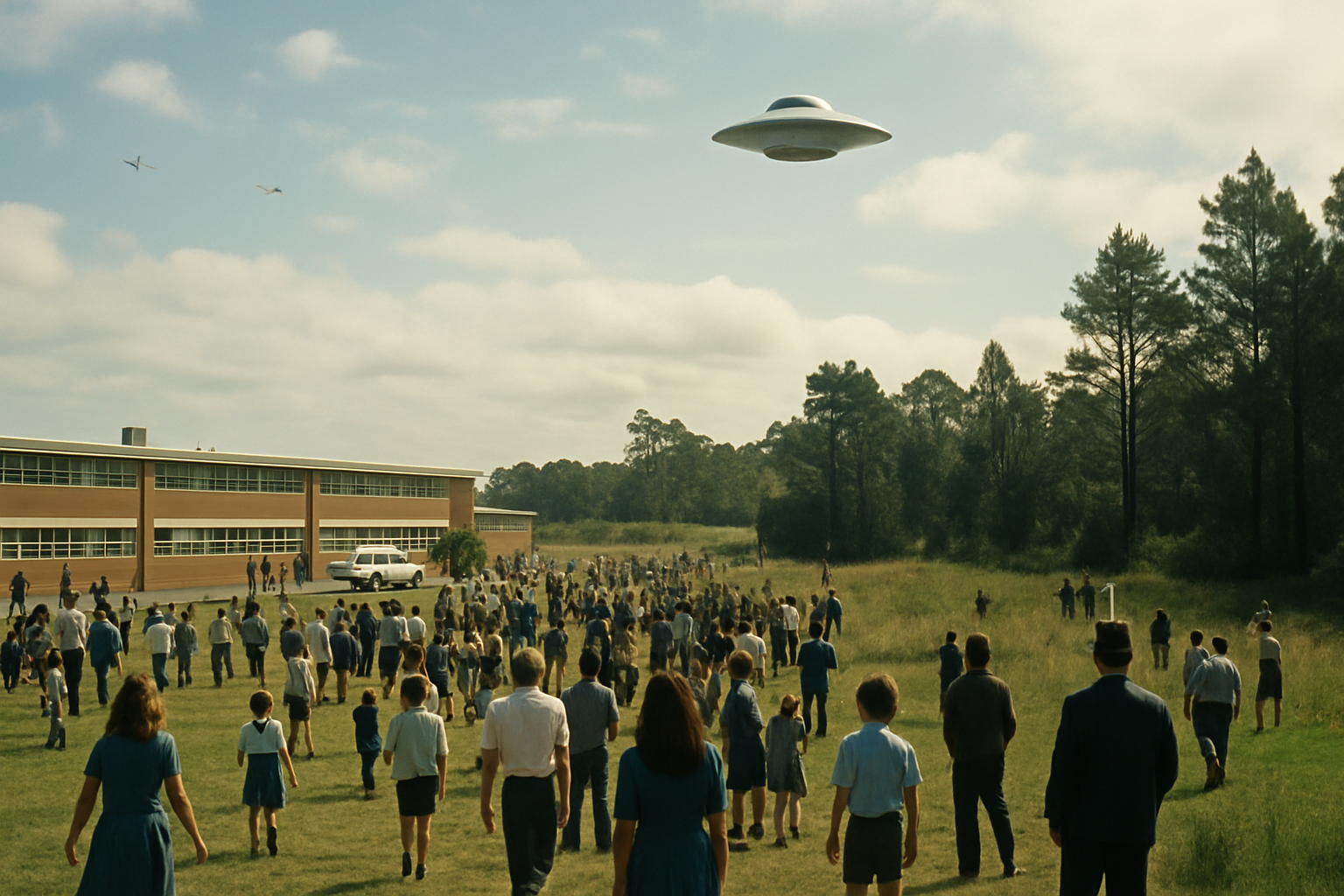
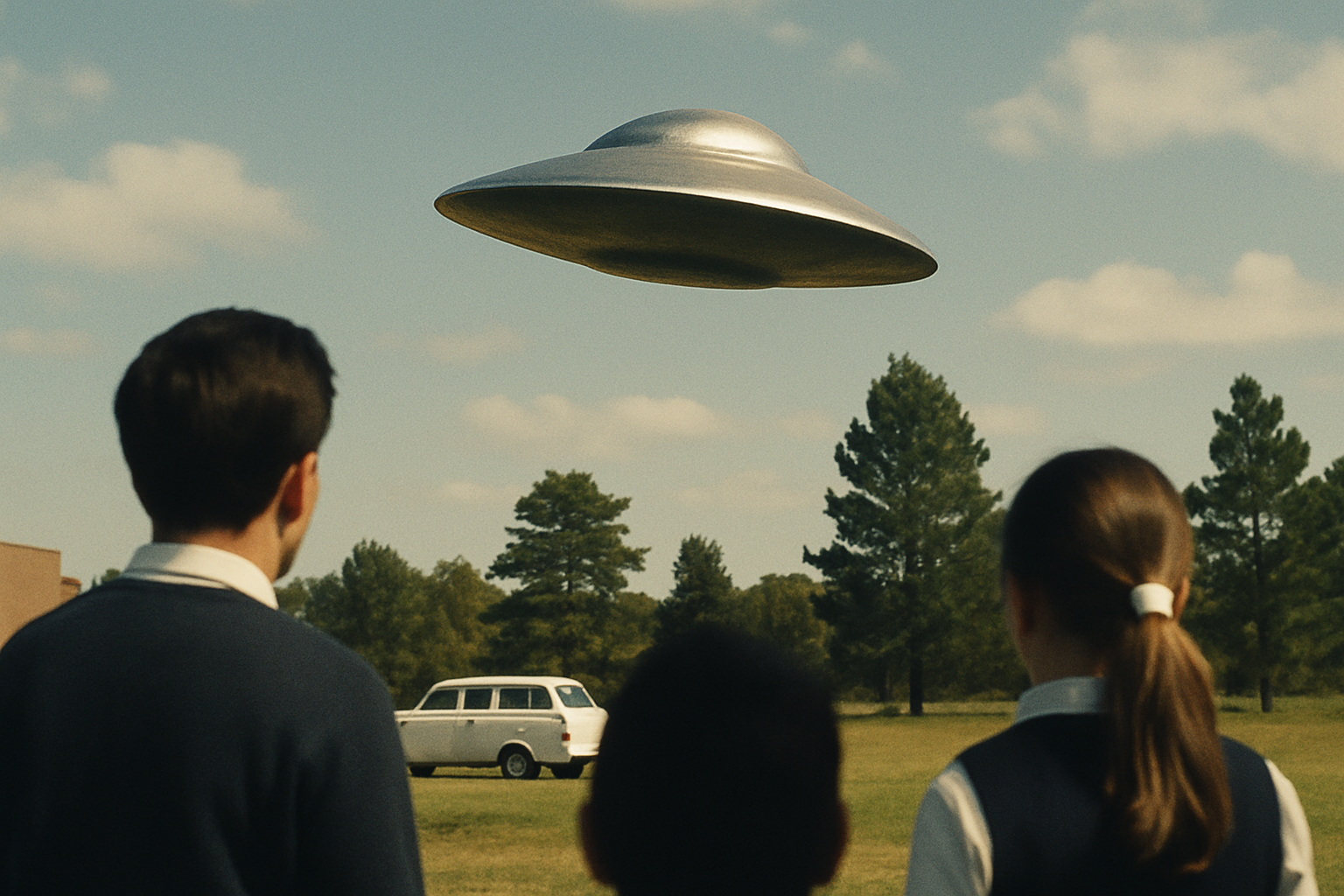
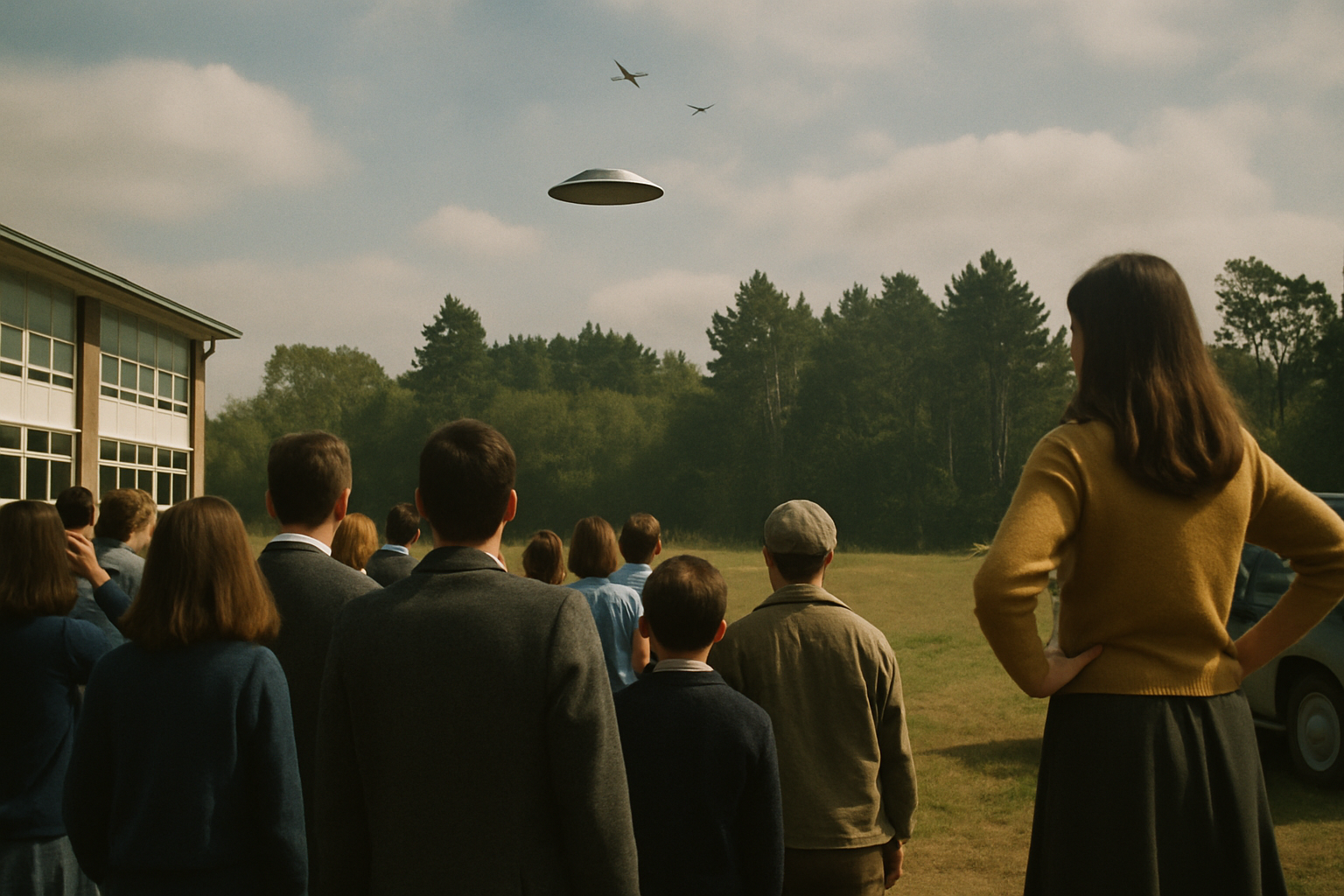
The Westall UFO refers to a mass daylight sighting reported on the morning of 6 April 1966 at Westall High School and a neighbouring primary school in Clayton South, a suburb of Melbourne, Victoria, Australia.[1] During morning break, students and teachers said they saw one or more silver-grey objects above the school grounds, which then descended toward an adjacent open area of grassland and pine trees known as The Grange before moving off to the north-west.[2][3] Some witnesses reported that several light aircraft appeared to follow or circle the object, and there were later, conflicting accounts of ring- or circle-shaped marks found on the ground.[1][4] Estimates of the number of witnesses range from about a hundred to several hundred, making it one of the most widely reported mass UFO sightings in Australian history.[3][2] No official UFO record of the event has been located in Royal Australian Air Force or Department of Defence files,[4] and skeptical writers most often attribute it to a weather balloon or to a stray balloon from the joint Australian–United States HIBAL high-altitude programme.[1][2] The case remains disputed and has been revisited in books, a 2010 documentary and local commemorations.[3]
Background
In 1966 Westall was a developing outer suburb of Melbourne in the City of Clayton (today within the City of Kingston).[2] Westall High School stood beside a primary school, and across from the campus lay an undeveloped tract of grassland and pine trees locally known as The Grange.[2][3] The schools were not far from Moorabbin Airport, so light aircraft and balloons were a familiar sight to many of the children and staff who later described the event.[2]
The sighting occurred on a clear autumn morning during a break between classes, when large numbers of students were outdoors on the school grounds.[3] The most contemporary documentation came from the local press — the Dandenong Journal ran reports on 14 and 21 April 1966 — and from a student publication, the *Clayton Calendar*, which printed an account that was later reproduced in an Australian flying-saucer review.[2]
The sighting
Accounts agree that the episode began when students on the school oval noticed one or more bright objects in the sky during morning break.[2][3] Witnesses generally described the main object as round with a domed top and silver, grey or white in colour; one widely quoted description put it at roughly "twice the size of a family car."[1] The science teacher Andrew Greenwood said the object was silver-grey and at times appeared to "thicken" as it manoeuvred.[4] Several accounts describe more than one object, with some witnesses reporting a larger craft accompanied by smaller ones.[4]
Many witnesses said the object descended behind trees into The Grange, with reports differing on whether it briefly landed, hovered or simply dropped low before climbing away to the north-west.[2][3] A recurring element of the testimony is that several light aircraft — often described as small Cessna-type planes — appeared to circle or pursue the object while it was in view.[4][1] The whole event was said to have lasted on the order of twenty minutes, though estimates vary.[3]
In the days afterward, some students reported finding circular marks in the grass at The Grange, variously described as burnt, flattened or pressed down, with accounts disagreeing on how many circles there were.[1] The landowner is said to have burned off the paddock not long afterward, and on a visit a few days later observers reported finding nothing of significance.[1]
Investigation and official response
There was no large, coordinated official inquiry comparable to government UFO investigations elsewhere, and the schools made no public statement at the time.[4] The civilian Victorian Flying Saucer Research Society interviewed witnesses but did not publish a comprehensive account, and the most detailed early record remained the local newspaper coverage and the student-magazine report.[2]
Researchers who later searched government archives reported that no corresponding UFO report could be found in Royal Australian Air Force or Department of Defence files, with some related records said to be unexamined or unavailable.[4] This absence of an official record has been read in opposite ways — as evidence of suppression by some witnesses, and as simply the unremarkable handling of an unverified sighting by skeptics.[3]
A persistent and disputed strand of the story concerns official pressure on witnesses. The teacher Andrew Greenwood later said that he had been visited and warned not to discuss the event, an account repeated in some later interviews; other witnesses described being told by authorities or school staff not to talk about what they had seen.[3] These claims are not supported by documentary evidence and are treated cautiously by historians of the case.[3]
Explanations and disputes
No physical proof of an extraordinary craft was ever produced, and the Westall event is best understood as disputed between an anomalous reading and conventional explanations.[1][3]
The earliest conventional explanation, reported in the press, was a weather balloon: the Bureau of Meteorology released a balloon from Laverton at about 8:30 a.m., and a westerly wind could in principle have carried it toward the school.[2][4] A more specific version, advanced by the Australian researcher Keith Basterfield, points to the joint Australian–United States HIBAL programme, which flew large silver high-altitude balloons (used in part to monitor radiation following British nuclear tests) and whose payloads descended by parachute; on this account a HIBAL balloon launched in the region may have drifted off course and come down near Westall, its silvery envelope, parachute and trailing gear matching parts of the description.[1][2] The science writer Brian Dunning has argued that a weather balloon is a plausible explanation for the first part of the event, with a military target drogue possibly accounting for the aircraft reports.[1]
More recently, skeptical commentators have emphasised the fragility of memory in a case where many witnesses were children and were not systematically interviewed until decades later, citing the influence of false memory and the way shared retellings can converge over time.[1]
Witnesses and proponents of an anomalous interpretation counter that, being familiar with aircraft and balloons from the nearby airport, they did not believe the object behaved like either; they point to its reported manoeuvres, the apparent pursuit by aircraft and the number of independent observers as features hard to reconcile with a drifting balloon.[2][4] On the available evidence the case remains unresolved: there is no physical proof of an extraordinary object, while the leading balloon explanations are plausible but not conclusively documented.[1][3]
Aftermath and significance
The Westall event became one of the best-known UFO cases in Australia and has been revisited repeatedly in the decades since.[3] A 40th-anniversary reunion of witnesses was held in 2006, and interest grew further with the 2010 documentary _Westall '66: A Suburban UFO Mystery_, directed by Rosie Jones and based in part on the research of Shane Ryan, who gathered well over a hundred eyewitness accounts.[3][1] The case has also featured in international UFO media.[1]
The site itself has been commemorated: the City of Kingston developed The Grange reserve with a walking track and a UFO-themed children's playground, marking the location in the local landscape.[1][2] Among educators and skeptics, Westall is frequently used as a teaching example for the critical analysis of eyewitness testimony and of how popular accounts of historical events are formed.[3]
Key quotes
“"About twice the size of a family car." — a frequently quoted description of the main object's size
“"Silver-grey and seemed to 'thicken' sometimes." — science teacher Andrew Greenwood describing the object
References
- 1.
- 2.
- 3.
- 4.
Similar cases
Scored on agency / year proximity / region / tag overlap — same agency +3, near year +4, same region +2, shared tag ×2.