Father Gill UFO sighting
Illustrations
AI-generated illustration — not actual footage or evidence; an interpretive depiction based on the documented account
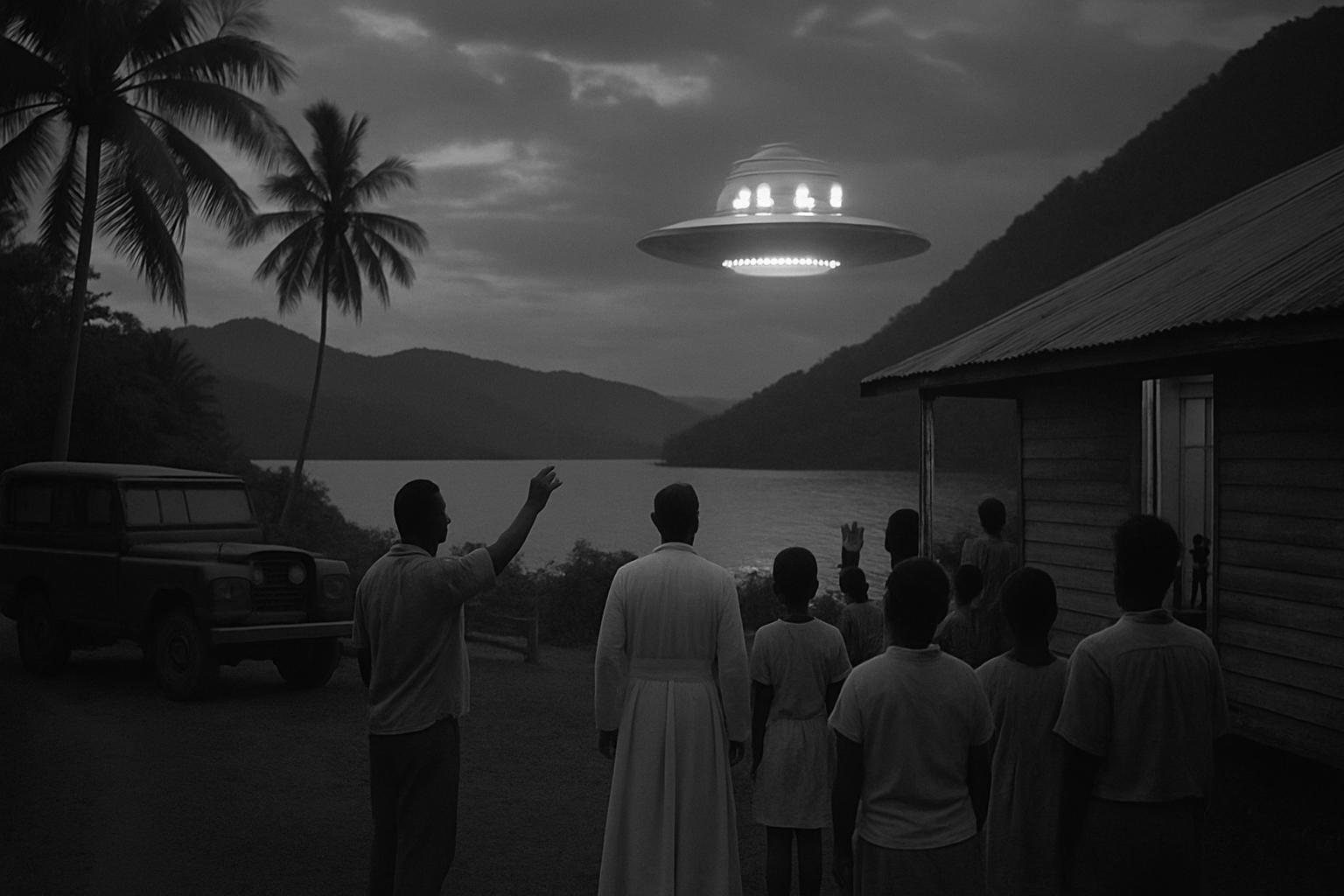
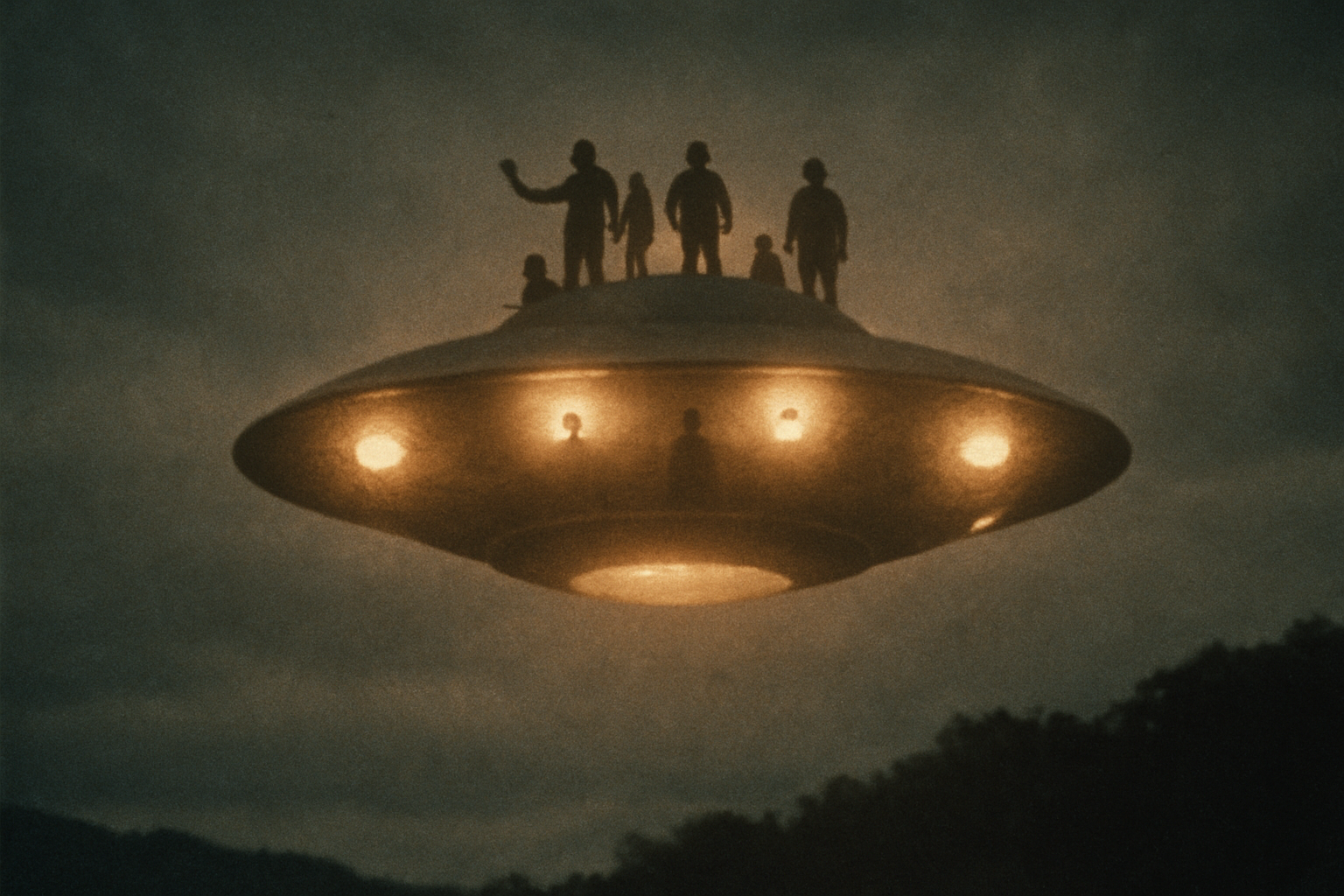
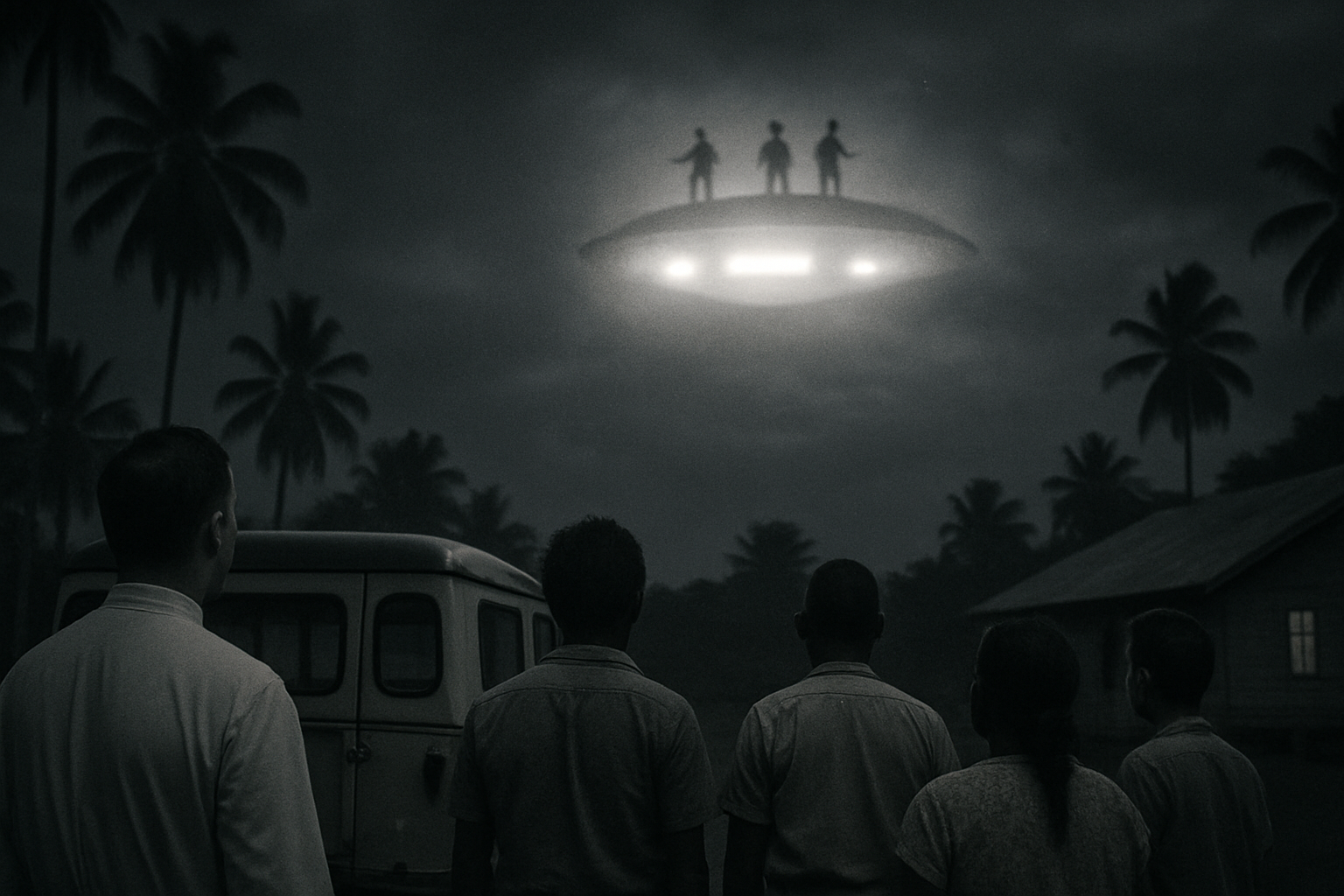
The Father Gill UFO sighting (also called the Boianai sighting) was a series of reported observations of an unidentified flying object on the evenings of 26–27 June 1959 at the Boianai Anglican mission station in what was then the Territory of Papua and New Guinea, on Goodenough Bay.[1][2] The principal witness was Father William Booth Gill, an Australian Anglican missionary in charge of the mission, who together with mission teachers, staff and local villagers — by his account some three dozen people — watched a large, disc-shaped luminous object on which figures resembling human beings appeared to move about on an upper deck.[1][3] On the second evening, witnesses said that when Gill and the teacher Ananias waved at the figures, the figures waved back, and that torch (flashlight) signals seemed to draw a response from the object.[1][2] The case is frequently cited in UFO literature because of the number and apparent reliability of its witnesses and because Gill kept a detailed written log and collected signatures from those present.[3][2] It was investigated by the Royal Australian Air Force, which attributed some of the lights to planets seen through cloud, and later studied by the astronomer J. Allen Hynek, who regarded the main object as not explicable astronomically; skeptical writers proposed misidentification of Venus or, in at least one case, a hoax, and the sighting remains unresolved.[3][2]
Background
Boianai is a coastal mission station on Goodenough Bay, in the Milne Bay region of eastern Papua New Guinea, which in 1959 was administered by Australia as the Territory of Papua and New Guinea.[2] Father William Booth Gill was the Anglican missionary in charge of the station; he is generally described as a careful and unexcitable observer, and J. Allen Hynek later characterised him in similar terms.[1][3]
The June 1959 observations did not occur in isolation. According to material later compiled by investigators, the New Guinea area saw a substantial number of UFO reports in 1958–1959, with dozens of sightings logged in the period.[3] Father Gill himself had reportedly noted earlier lights before the well-documented events of 26–27 June.[1]
The reported sightings
By Gill's account, on the evening of 26 June 1959 the teacher Stephen Gill Moi drew his attention to a bright light over the sea. At about 6:45 p.m. Gill and others saw a large object that he described as solid and circular, with a wide base and a narrower upper deck, supported on what looked like four legs, with several glowing panels or apertures on its side and a beam of blue light projecting upward at an angle.[1][3] On the upper deck, observers reported seeing figures resembling men — at times four of them — that appeared to move about and, on occasion, to lean over as if working on something.[1][2] The object was watched for an extended period that evening, disappearing and reappearing among the clouds, and smaller lights were also reported.[1] Roughly two dozen people, including teachers and medical staff at the mission, were said to have observed the phenomena, and Gill recorded a list of witnesses.[3][2]
The most-discussed episode came on the second evening, 27 June 1959. The large object returned with figures again visible on top. Gill said that he raised his arm and waved, and that one of the figures appeared to wave back; when the teacher Ananias also waved with both arms, two of the figures responded in kind.[1][2] Gill and others then signalled with a torch, and the object was reported to make several wavering or back-and-forth movements that the witnesses took as a response.[1][3] In a much-quoted detail, the witnesses afterwards went to dinner, the object still in view, an apparent ordinariness that observers have often remarked upon.[2] The object did not land, no occupants descended, and no physical traces were left.[3]
Investigation and official response
Father Gill compiled a written report of the events and obtained the signatures of mission members who had witnessed them; accounts state that about 25 people signed.[3][2] His notes circulated and reached the press, and reports of the sightings caused a sensation when they appeared later in 1959.[1]
The Royal Australian Air Force (RAAF) examined the case. According to the available accounts, an RAAF officer interviewed Gill some months after the events, and an assessment attributed parts of the sightings — particularly the smaller lights — to the planets Jupiter, Saturn and Mars seen through moving cloud, with refraction and the motion of the cloud held to account for apparent movement.[3]
The case was later taken up by the American astronomer J. Allen Hynek, scientific consultant to the U.S. Air Force's UFO studies and founder of the Center for UFO Studies, and is also discussed in the work of Jacques Vallée.[2][3] In 1973 — some fourteen years after the events — Hynek travelled to Australia and Papua New Guinea and located several of the original witnesses, who are reported to have reaffirmed their accounts.[3][2] Hynek distinguished the lesser lights, which he allowed might be astronomical, from the main object, which, given its described size and near-stationary presence over an extended period, he considered could not be reduced to a star or planet.[3][2]
Explanations and disputes
Several conventional explanations have been advanced, none of which has produced a consensus.
- Planets and atmospheric effects. The RAAF assessment held that some of the lights were planets — Jupiter, Saturn and Mars — viewed through cloud, with refraction and cloud movement creating impressions of motion.[3]
- Venus and visual error. The Harvard astronomer Donald H. Menzel, a prominent UFO skeptic, argued that the bright object was the planet Venus near peak brightness and that the figures could be explained as artefacts of distorted vision, on the assumption that Gill was myopic and astigmatic and not wearing corrective glasses.[2] Against this, Gill stated that he was wearing properly corrected spectacles — a point said to have been confirmed by Hynek's colleague Fred Beckman — and he had separately pointed out Venus as a distinct object in the sky that same night.[1][2]
- Hoax. The skeptic Philip J. Klass and others suggested the possibility of a deliberate hoax by the priest, an interpretation that proponents reject given Gill's standing, his contemporaneous written record, and the number of corroborating witnesses.[2]
- Other mundane hypotheses. Later commentators have proposed further everyday explanations, such as the misperception of an unfamiliar lit vessel or atmospheric mirage; these remain conjectural.[2]
Proponents and several investigators consider the multiple-witness testimony, the reported interactive response to waving and torch signals, and the extended duration difficult to reconcile with a purely astronomical or single-cause explanation.[1][3] Because no physical evidence survives and the competing explanations are contested, the sighting is generally treated as unexplained rather than resolved.[3][2]
Aftermath and significance
The Father Gill sighting became one of the most frequently cited cases in UFO literature, valued by proponents for its combination of an articulate, professionally credible primary witness, a large group of secondary witnesses, and a detailed contemporaneous record.[3][2] It is regularly classed among the more notable "close encounter" reports of the late 1950s.[2]
The case has retained attention partly because of its unresolved status: the witnesses, including those re-interviewed by Hynek in 1973, are reported to have maintained their accounts, while skeptical explanations — Venus, planets through cloud, visual distortion, or a hoax — have not won general acceptance.[3][2] It continues to be discussed in surveys of historically significant UFO sightings, in part as an example of a multiple-witness report that resisted straightforward conventional explanation.[1][2]
Key quotes
“By Gill's account, when he raised his arm and waved, the figure on the object "did the same."
References
- 1.
- 2.
- 3.
Similar cases
Scored on agency / year proximity / region / tag overlap — same agency +3, near year +4, same region +2, shared tag ×2.