1561 celestial phenomenon over Nuremberg
Illustrations
AI-generated illustration — not actual footage or evidence; an interpretive depiction based on the documented account
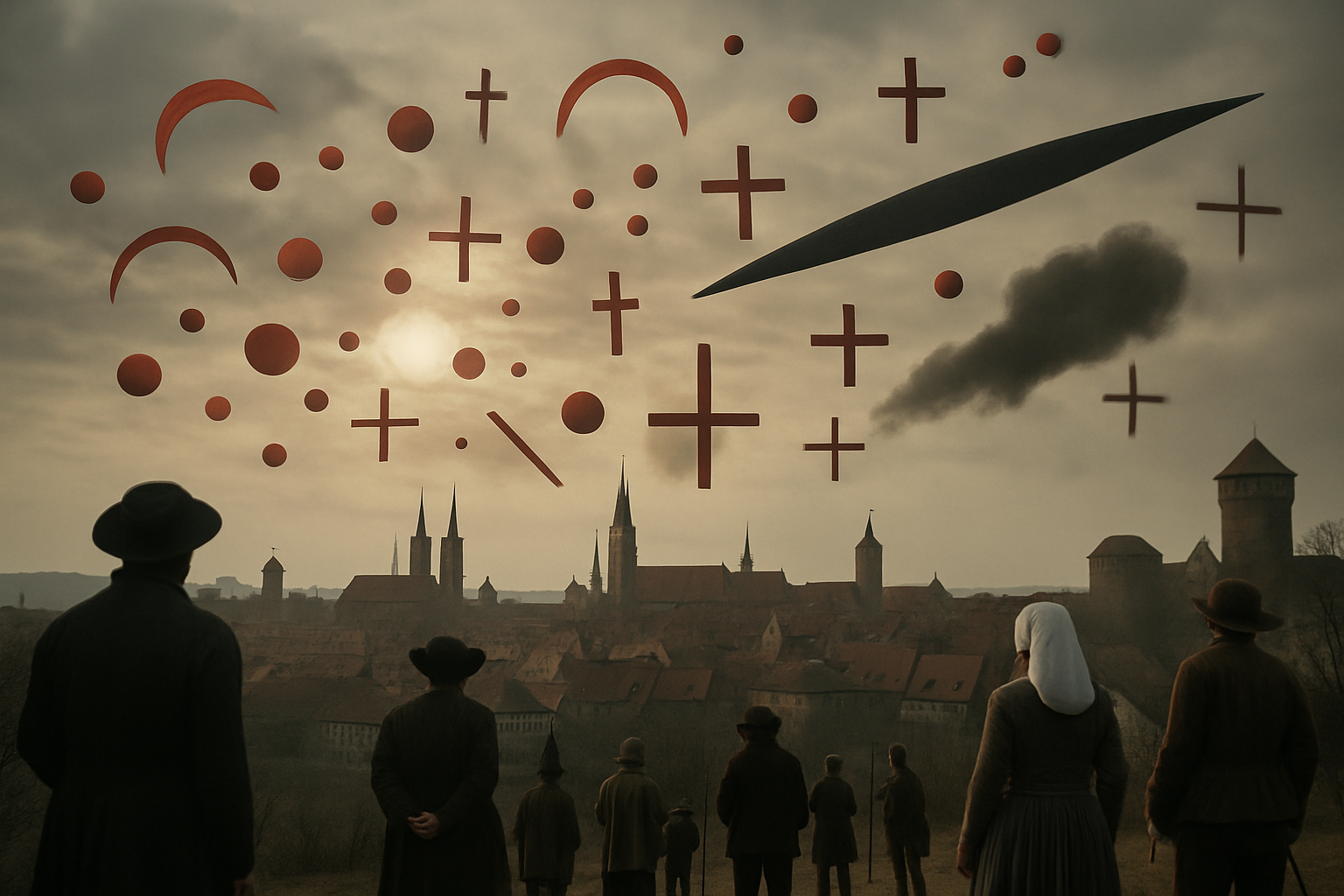
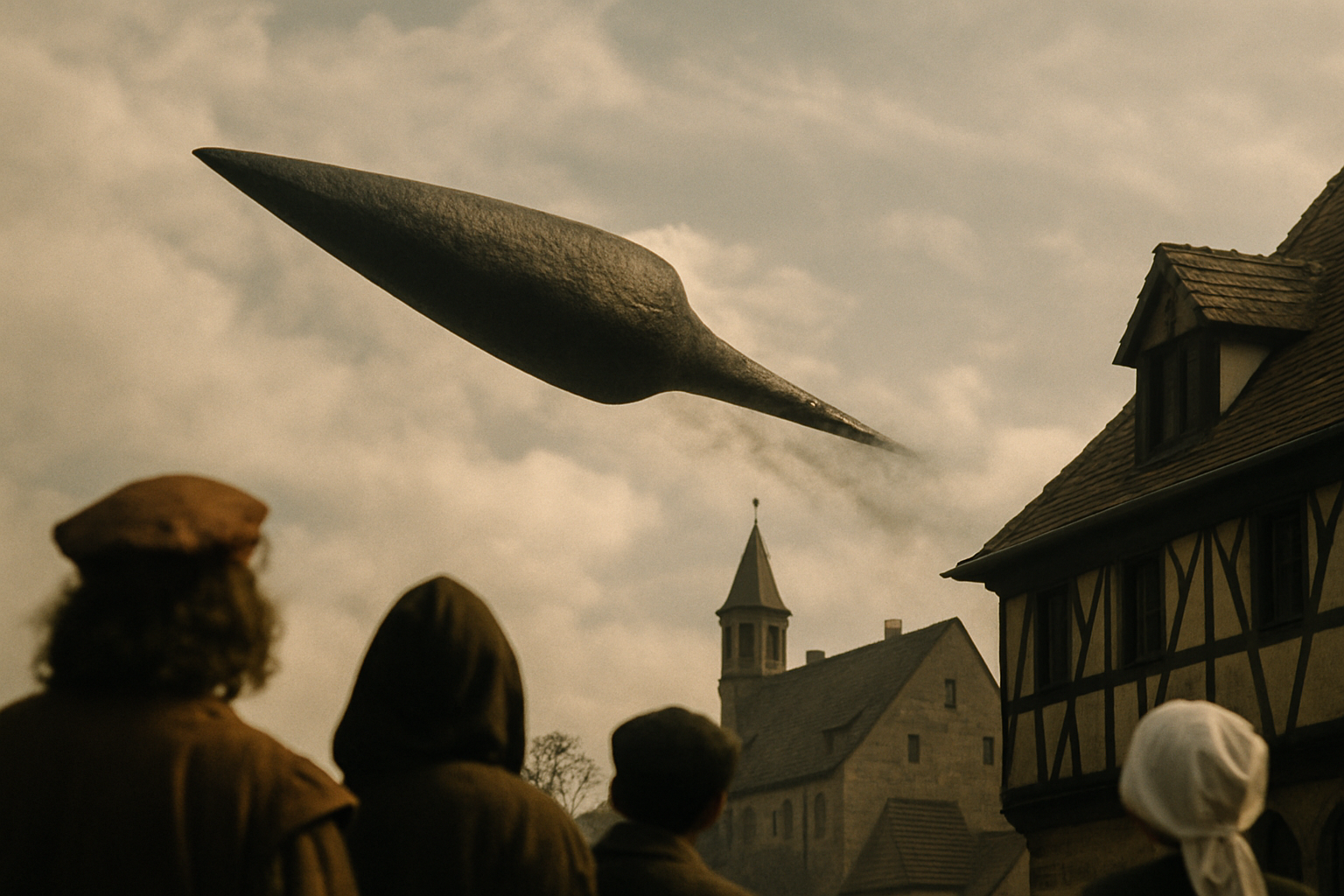
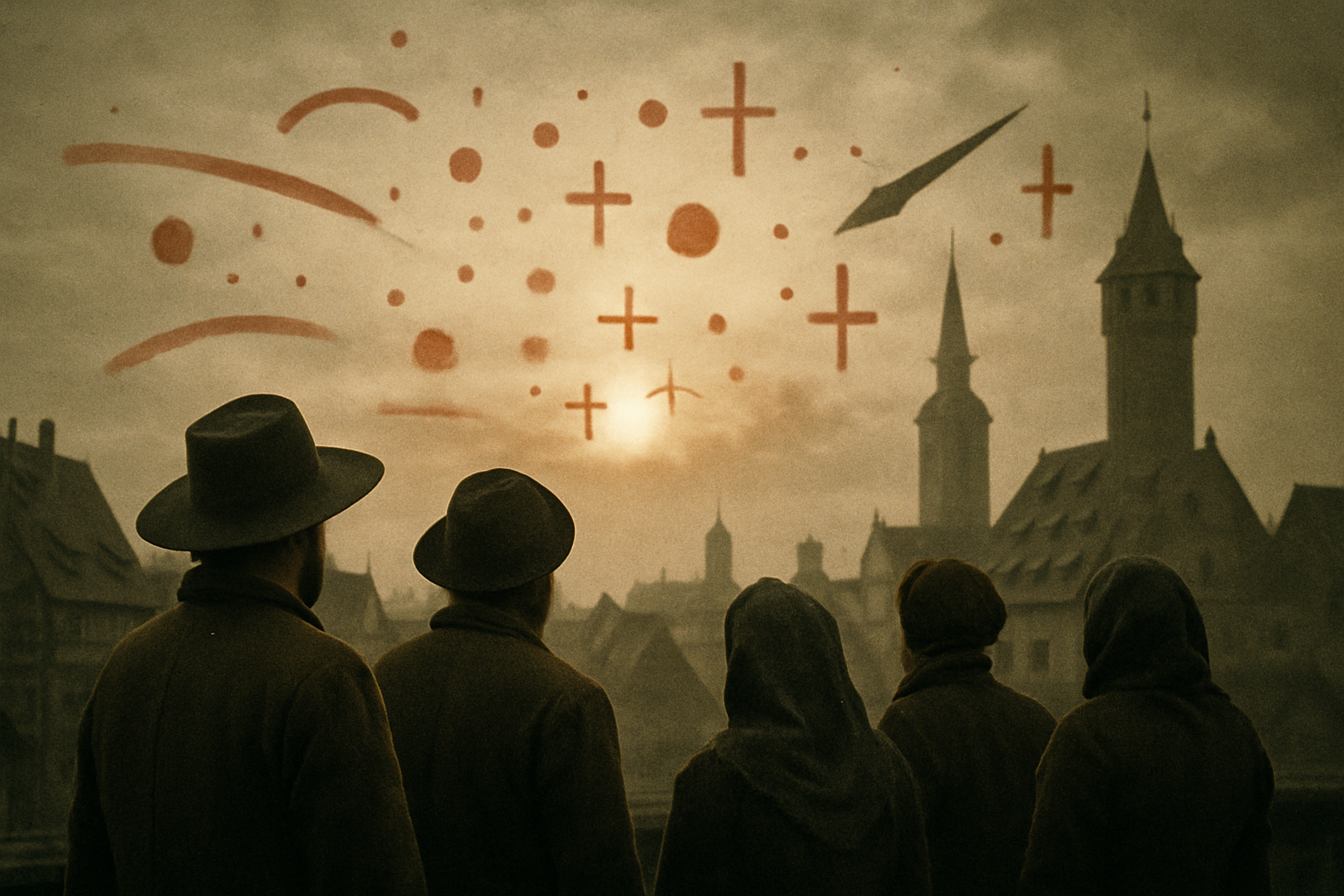
The 1561 celestial phenomenon over Nuremberg was a mass sighting of unusual aerial objects reported by residents of Nuremberg, then a Free Imperial City of the Holy Roman Empire, on the morning of 14 April 1561.[1] The event is known almost entirely through a single illustrated broadsheet printed by the local letter-painter Hans Glaser, which describes and depicts blood-red arcs, spheres, crosses, cylinders and a long black spear-shaped object appearing around the sun and seemingly "fighting" one another for about an hour before falling to earth amid smoke.[2]
The broadsheet framed the spectacle in religious terms, treating it as a divine sign calling for repentance, in keeping with the German tradition of *Wunderzeichen* ("wonder sign") prints.[1] The episode received little modern attention until the psychiatrist Carl Jung discussed it in his 1958 study *Flying Saucers: A Modern Myth of Things Seen in the Skies*.[1] Since then it has become one of the most frequently cited pre-modern "UFO" cases, though most researchers interpret it as a religiously and militarily framed account of an atmospheric optical phenomenon such as a sun dog.[1]
Background
In 1561 Nuremberg was one of the largest and most prosperous Free Imperial Cities of the Holy Roman Empire and a major centre of printing.[1] The decades following the Reformation saw a flourishing market for single-sheet *Wunderzeichen* or "wonder sign" broadsheets, which reported comets, unusual weather, monstrous births and strange lights in the sky and interpreted them as portents of divine displeasure.[1] Such prints typically combined a striking woodcut image with an explanatory text and a moralising or apocalyptic message.[2]
The Nuremberg account belongs squarely to this genre. It was produced by Hans Glaser, described as a letter-painter (*Briefmaler*) of the city, who both illustrated and set the accompanying text.[2] Because literacy was limited, broadsheets of this kind were designed so that the image alone could carry much of the message to a largely viewing rather than reading public.[1]
The reported event
According to Glaser's broadsheet, at dawn on 14 April 1561 "many men and women" of Nuremberg saw a dreadful apparition in the sky.[2] The account states that there first appeared in or beside the sun two blood-red semi-circular arcs, and then a great number of additional objects of varied shape and colour.[2]
The text and woodcut describe round balls or spheres, some bright red and some "of partly dull, partly black ferrous colour," together with blood-red crosses, rod- or cylinder-shaped forms, and crescent shapes arrayed around the sun.[2] These objects are said to have moved and collided as if in combat for more than an hour, after which they appeared to weaken and fall from the sky toward the earth, where they were consumed "as if they all burned" amid a great quantity of smoke.[1] A single large black spear-shaped object is described as lying across the scene, its shaft pointing east and its point toward the west.[2] Glaser closed by interpreting the display as a warning from God urging the people to repentance.[1]
The broadsheet and its preservation
The sole near-contemporary record of the event is Glaser's broadsheet, a hand-coloured woodcut with letterpress text measuring approximately 26.2 by 38.0 centimetres.[1] The original survives in the prints and drawings collection of the Zentralbibliothek Zürich in Zürich, Switzerland, and has been digitised and made publicly available.[1][2]
No independent civic, church or chronicle records from 1561 are commonly cited alongside the print, so essentially all detail about the sighting derives from Glaser's single sheet.[1] The image was reproduced in Carl Jung's 1958 book on flying saucers, which brought it to a twentieth-century audience and established it as a recurring reference in later UFO literature.[1]
Explanations and disputes
Most commentators treat the broadsheet as a religiously and militarily coloured account of a natural sky display rather than a literal record of solid craft.[1] The leading conventional explanation is an atmospheric optical phenomenon, in particular a sun dog (parhelion) or a more complex halo display, in which refraction of sunlight through ice crystals can produce coloured arcs, bright spots and cross-like patterns around the sun.[1] Critics note, however, that the elaborate scene in the woodcut does not closely match the classic appearance of a simple sun dog, and that the artist may have stylised and embellished a secondhand report to fit the expectations of the *Wunderzeichen* genre.[3]
Carl Jung, who reproduced the image in 1958, regarded the spectacle as most plausibly a natural phenomenon interpreted through the religious and military imagery familiar to sixteenth-century Europeans, and used it as material for his psychological analysis of the "flying saucer" as a modern myth.[1] By contrast, some later ufologists have suggested that the objects represent extraterrestrial spacecraft engaged in an aerial battle, an interpretation that mainstream historians and scientists regard as unsupported by the evidence.[1] Because the case rests on a single, religiously framed and artistically stylised source, its precise nature remains disputed.
Aftermath and significance
After 1561 the event was largely forgotten outside collections of early printed broadsheets, surviving mainly as an artefact of sixteenth-century portent literature.[1] Its modern prominence dates from Jung's 1958 *Flying Saucers: A Modern Myth of Things Seen in the Skies*, after which the Glaser image became a staple illustration in popular books, articles and documentaries about historical UFO sightings.[1]
Today the broadsheet is valued both as a vivid example of Reformation-era *Wunderzeichen* printing and as a frequently debated entry in the catalogue of pre-modern aerial sightings.[2] It is often discussed together with a comparable 1566 broadsheet describing strange globes over Basel, and it continues to feature in debates over how far early modern "sky battle" reports reflect real atmospheric events, religious imagination, or both.[1]
Key quotes
“"At first there appeared in the middle of the sun two blood-red semi-circular arcs... and in the sun, above and below and on both sides, the colour was blood, there stood a round ball of partly dull, partly black ferrous colour."
References
- 1.
- 2.
- 3.
Similar cases
Scored on agency / year proximity / region / tag overlap — same agency +3, near year +4, same region +2, shared tag ×2.